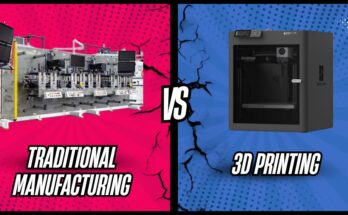
Manufacturing in India is changing fast. For many years, businesses have relied on traditional manufacturing methods like injection molding, CNC machining, and casting. These methods still work well, especially for large-scale production. However, 3D printing is now changing the way companies think about making products, testing ideas, and bringing new designs to market.
Understanding traditional manufacturing vs 3D printing can help businesses choose the right method for their needs. In this blog, you will learn how traditional manufacturing and 3D printing are different, their costs, speed, and design limits, and when each method works best. This will help you decide which technology is right for your business and how you can save time, reduce costs, and improve product quality.
What is Traditional Manufacturing?
Traditional manufacturing refers to conventional production methods that have been refined over decades. These include processes like injection molding, CNC machining, casting, forging, and subtractive manufacturing techniques.
In traditional manufacturing, products are typically made by either removing material from a solid block (subtractive manufacturing) or by pouring material into molds (formative manufacturing). These methods require significant setup time, specialized tooling, and are generally most cost-effective for large production runs.
Common Traditional Manufacturing Methods
Injection Molding: Molten plastic is injected into metal molds to create parts. This method is excellent for mass production but requires expensive molds that can cost lakhs of rupees.
CNC Machining: Computer-controlled machines cut away material from solid blocks to create precise parts. While accurate, this process wastes significant material and requires skilled operators.
Casting: Liquid metal or other materials are poured into molds and allowed to solidify. This ancient technique is still widely used but has limitations in design complexity.
What is 3D Printing?
3D printing, also known as additive manufacturing, builds objects layer by layer from digital designs. Instead of cutting away material or using molds, 3D printers add material precisely where needed, creating complex shapes that would be impossible or extremely expensive with traditional methods.
The process starts with a digital 3D model created in CAD software. This model is then sliced into thin horizontal layers, and the 3D printer builds the object by depositing material layer by layer until the complete part is formed.
Popular 3D Printing Technologies
FDM (Fused Deposition Modeling): Melts plastic filament and deposits it layer by layer. This is the most affordable and widely used technology.
SLA (Stereolithography): Uses UV light to cure liquid resin into solid parts, offering exceptional detail and smooth surfaces.
SLS (Selective Laser Sintering): Uses lasers to fuse powder materials, creating strong functional parts without support structures.
Key Differences: Traditional Manufacturing vs 3D Printing
1. Initial Setup Costs
Traditional Manufacturing: Requires significant upfront investment in tooling, molds, and dies. For injection molding, mold costs can range from ₹50,000 to ₹25 lakhs depending on complexity. This makes it economically viable only for large production runs.
3D Printing: Minimal setup costs. Once you have a 3D printer, you can start producing parts immediately from digital files. No expensive tooling or molds required. This makes 3D printing ideal for small batches, prototypes, and custom products.
2. Production Speed for Prototypes
Traditional Manufacturing: Creating prototypes is time-consuming. You need to design tooling, manufacture molds, and then produce sample parts. This process can take weeks or even months.
3D Printing: Print prototypes in hours or days directly from digital designs. Make design changes quickly and print new versions the same day. This rapid iteration accelerates product development dramatically.
3. Design Complexity and Freedom
Traditional Manufacturing: Limited by the constraints of the manufacturing process. Undercuts, internal channels, and complex geometries often require multiple parts and assembly. Design for manufacturability restricts creativity.
3D Printing: Enables unprecedented design freedom. Create complex internal structures, organic shapes, and consolidated parts that would be impossible to manufacture traditionally. Hollow structures, lattice designs, and topology-optimized parts are all possible.
4. Material Waste
Traditional Manufacturing: Subtractive processes like CNC machining can waste 40-90% of the raw material. While some materials can be recycled, waste represents significant cost and environmental impact.
3D Printing: Uses only the material needed to build the part. Minimal waste makes it more sustainable and cost-effective, especially for expensive materials. Some technologies allow unused powder to be recycled for future prints.
5. Customization and Personalization
Traditional Manufacturing: Every custom variation requires new tooling or setup changes, making customization expensive. Mass production of identical items is the sweet spot.
3D Printing: Each print can be completely different without additional cost or setup time. Perfect for personalized products, custom medical devices, dental applications, and made-to-order items.
6. Inventory and Storage
Traditional Manufacturing: Requires producing large quantities to justify tooling costs. This means maintaining inventory, which ties up capital and requires storage space.
3D Printing: Enables on-demand manufacturing. Print parts as needed, reducing inventory costs and storage requirements. This is particularly valuable for spare parts and low-volume items.
7. Production Volume Economics
Traditional Manufacturing: Cost per unit decreases significantly with volume. Becomes highly economical for thousands or millions of identical parts.
3D Printing: Cost per unit remains relatively constant regardless of quantity. Most economical for small batches (1-1000 units, depending on part size and complexity).
|
Aspect |
Traditional Manufacturing |
3D Printing |
|
Process |
Subtractive/formative: machining, casting, molding, forging |
Additive: builds objects layer-by-layer from digital CAD models |
|
Setup Costs |
High due to tooling, molds, and specialized machinery |
Low, requires only printer setup and raw material |
|
Production Speed |
Efficient for mass production, slower for prototypes |
Fast for prototyping, slower for large-scale production |
|
Material Utilization |
More waste from cutting/removal |
Minimal waste, material added only where needed |
|
Customization |
Limited, costly to retool |
Highly flexible, easy to customize each unit |
|
Design Complexity |
Restricted by tooling/mold limitations |
Can produce intricate geometries and internal structures |
|
Scalability |
Excellent for high-volume production |
Best for small batches or unique items |
|
Labor Requirements |
Skilled labor for machining, assembly, and quality control |
Lower labor needs, mostly digital workflow |
|
Material Options |
Wide range: metals, plastics, composites |
Growing range, but still narrower than traditional |
|
Sustainability |
Higher waste, energy-intensive |
Lower waste, potential for eco-friendly materials |
Real-World Applications: Where Each Method Excels
When Traditional Manufacturing is Best
-
Mass production of simple parts (10,000+ units)
-
High-strength metal parts requiring specific material properties
-
Products with very tight tolerances consistently across millions of units
-
Continuous production runs of established products
-
Industries with established supply chains and tooling infrastructure
When is 3D Printing the Best Solution?
Prototyping and Product Development: Quickly iterate designs without expensive tooling. Indian startups and R&D departments are increasingly using 3D printing to accelerate innovation.
Low-Volume Production: Manufacture specialized parts, custom jigs and fixtures, or limited-edition products economically.
Spare Parts and Maintenance: Print replacement parts on demand instead of maintaining expensive inventory. This is revolutionizing aerospace, automotive, and industrial maintenance.
Medical and Dental: Create patient-specific surgical guides, dental aligners, prosthetics, and anatomical models. Indian healthcare providers are adopting 3D printing for personalized treatment.
Education and Research: Universities and technical institutes across India use 3D printing for hands-on learning and research projects.
Architecture and Construction: Create detailed scale models, custom building components, and explore innovative construction methods.
Jewellery and Fashion: Design complex patterns and custom pieces that would be difficult or impossible with traditional methods.
The Hybrid Approach: Best of Both Worlds
Progressive manufacturers in India are not choosing between traditional manufacturing and 3D printing—they’re using both strategically. This hybrid approach leverages the strengths of each technology.
Use 3D printing for rapid prototyping and design validation, then transition to traditional manufacturing for mass production. Use 3D printing for custom tooling, jigs, and fixtures that support traditional manufacturing processes. Manufacture complex, low-volume components with 3D printing while producing high-volume standard parts traditionally.
Cost Comparison Example
Let’s consider a small plastic component for an electronic device:
Traditional Manufacturing (Injection Molding):
-
Mold cost: ₹2,00,000
-
Per unit cost (at 10,000 units): ₹5
-
Total cost for 10,000 units: ₹2,50,000
-
Cost per unit: ₹25
3D Printing:
-
No tooling cost: ₹0
-
Per unit cost: ₹50
-
Total cost for 10,000 units: ₹5,00,000
-
Cost per unit: ₹50
For 100 units:
-
Traditional: ₹2,00,000 + (100 × ₹5) = ₹2,00,500 (₹2,005 per unit)
-
3D Printing: 100 × ₹50 = ₹5,000 (₹50 per unit)
This example clearly shows the break-even point. 3D printing is dramatically more economical for low volumes, while traditional manufacturing becomes cost-effective at scale.
The Future of Manufacturing in India
India’s manufacturing sector is embracing 3D printing technology across industries. From automotive giants, prototyping new vehicle components to small businesses creating custom products, 3D printing is democratizing manufacturing.
Government initiatives like “Make in India” and “Atmanirbhar Bharat” are encouraging technological adoption. As 3D printing technology becomes more accessible and affordable, Indian businesses of all sizes can compete globally by reducing development time and costs.
Technology is advancing rapidly. New materials, faster print speeds, and larger build volumes are expanding what’s possible. Industrial-grade 3D printers are now producing end-use parts, not just prototypes, in industries from aerospace to healthcare.
Making the Right Choice for Your Business
Choosing between traditional manufacturing and 3D printing depends on several factors:
Production Volume: How many units do you need? Lower volumes favour 3D printing.
Time to Market: How quickly do you need to start production? 3D printing accelerates development.
Design Complexity: Does your product have complex geometries or internal features? 3D printing enables complex designs.
Customization Requirements: Do you need to customize products for different customers? 3D printing excels at mass customization.
Budget Constraints: What’s your initial investment capacity? 3D printing has lower entry costs.
Material Requirements: What material properties do you need? Consider what each technology can offer.
How 3Ding Can Help Your Business
At 3Ding, we understand that navigating the world of 3D printing can be overwhelming. As India’s trusted 3D printer supplier, we help businesses across the country harness the power of additive manufacturing.
Whether you’re a startup looking to prototype your first product, an educational institution wanting to provide hands-on learning experiences, or an established manufacturer exploring additive manufacturing for production, we have the right solution.
We offer a comprehensive range of 3D printers suitable for different applications and budgets—from entry-level FDM printers perfect for beginners to industrial-grade systems for demanding production environments. Our expert team provides consultation to help you choose the right technology, ongoing technical support to keep you printing successfully, training programs to build your team’s 3D printing expertise, and access to quality materials and maintenance services.
Take the Next Step
The manufacturing revolution is here, and 3D printing is no longer just for large corporations with massive budgets. Indian businesses of all sizes are using this technology to innovate faster, reduce costs, and compete globally.
Don’t let your competition get ahead. Whether you’re ready to invest in your first 3D printer or want to explore how 3D printing can benefit your specific application, 3Ding is here to help.
Contact us today to discuss your requirements, see live demonstrations of various 3D printing technologies, and discover how additive manufacturing can transform your business. Visit our website or call our expert team to schedule a consultation.
The future of manufacturing is additive. The future is now. The future is with 3Ding.
Ready to explore 3D printing for your business? Contact 3Ding today and take the first step toward manufacturing innovation.
FAQs related to Traditional Manufacturing Vs 3D Printing
1. Will 3D printing replace traditional manufacturing?
No, 3D printing won’t replace traditional manufacturing, but they’ll coexist. Traditional manufacturing is best for mass production (10,000+ units) with lower per-unit costs, while 3D printing excels at prototyping, low-volume production, and custom parts. The future is using both strategically, based on your production needs.
2. How does 3D printing compare to traditional ways of making things?
3D printing builds objects layer by layer without molds or tooling, while traditional manufacturing cuts material away or uses expensive molds. 3D printing offers faster prototyping, zero setup costs, design freedom, and 90% less waste, but traditional manufacturing is better for high-volume production. Each method has distinct advantages depending on quantity and complexity.
3. What costs does 3D production eliminate from traditional manufacturing?
3D printing eliminates tooling and mold costs, setup costs, inventory storage, material waste (40-90% savings), and minimum order requirements. This makes manufacturing accessible for Indian startups without massive upfront investment. You can start producing parts immediately from digital files.
4. What is the difference between 3D printing and traditional printing?
Traditional printing applies ink to paper in 2D, creating flat images and text. 3D printing creates three-dimensional physical objects by depositing materials like plastic or metal layer by layer. They’re completely different processes, one produces documents, the other produces functional parts and products.
5. What are the disadvantages of traditional manufacturing?
Traditional manufacturing requires high upfront costs (tooling costs lakhs), long setup times (weeks to months), and forces minimum order quantities. It also wastes 40-90% of materials, restricts design complexity, and makes customization expensive. These barriers make it challenging for startups and small businesses to innovate affordably.